SEN Students Hit Record 71,000: The Hardest Part of Inclusive Education Is Belonging
The latest Education Bureau figures tell a striking story: in the 2025/26 school year, more than 71,000 students with special educational needs (SEN) are studying in public mainstream primary and secondary schools. That is 3,870 more than the year before, and a cumulative rise of 26.7% over six years. The 2026/27 government budget sets aside around HK$4.43 billion for support.
Behind the numbers is an even more sobering reality: the ratio of speech therapists to students is just 1:100, against an international benchmark of 1:50. In some schools with higher SEN intakes, SEN students can make up as much as 40% of the student body. The number of secondary students with mental illness has surged 1.4 times in six years. Resources are stretched, that is a fact. But would fixing the resources be enough to make inclusive education work?
🏫 The dilemma of pull-out support
Many schools today rely on "pull-out support", taking the SEN child out of the classroom for separate training. There is sound reasoning behind it: in a small-group or one-to-one setting, the child can focus better, and the teacher can tailor support to their needs. This is necessary crisis management.
But front-line voices warn: if pull-out support becomes the norm, a child who is constantly taken out of class can easily develop the feeling that "I am different from the others." That feeling erodes a sense of belonging. In truth, the hardest challenge of inclusive education has never been resources; it is helping every child genuinely feel: I belong here.
🔬 Evidence: Psychologists Baumeister and Leary (1995), writing in Psychological Bulletin, argued that the need to belong is one of the most fundamental human motivations, as basic as eating or feeling safe. When a child feels they do not belong to the group, both their motivation to learn and their emotional wellbeing suffer.
🏷️ The weight of a label
The SEN label exists so children can get the support they need. But a label is a double-edged sword: when a child is constantly referred to as "the SEN student" or "the one with the problem", they, and even their classmates, can slowly stop seeing the real person and see only the label.
From our perspective, SEN does not mean "problem student". These are children who simply learn differently and have different emotional needs. They may learn a little more slowly, feel their senses more keenly, or need more time to process. But they have their own gifts, they want to be understood, and they want someone to listen.
🌐 The whole system is the answer
The assessments and individual training of traditional Western psychology are systematic and genuinely useful. A standardised set of tools can show clearly where a child needs support, and that is hard to dispute. But what holistic psychology seeks to add is this: inclusive education is not the case of a single child. It is a matter for the whole system.
Inside that system are teachers, peers, family, and school culture. When a child walks back into the classroom, what they feel is how their classmates treat them, how the teacher sees them, and how their parents support them at home. When any one of these breaks down, a crack opens in their sense of belonging.
So making inclusive education work is not only about adding a few speech-therapist posts, although we very much should. It is about making the whole school culture genuinely accept that everyone has different needs. The whole is always greater than the sum of its parts.
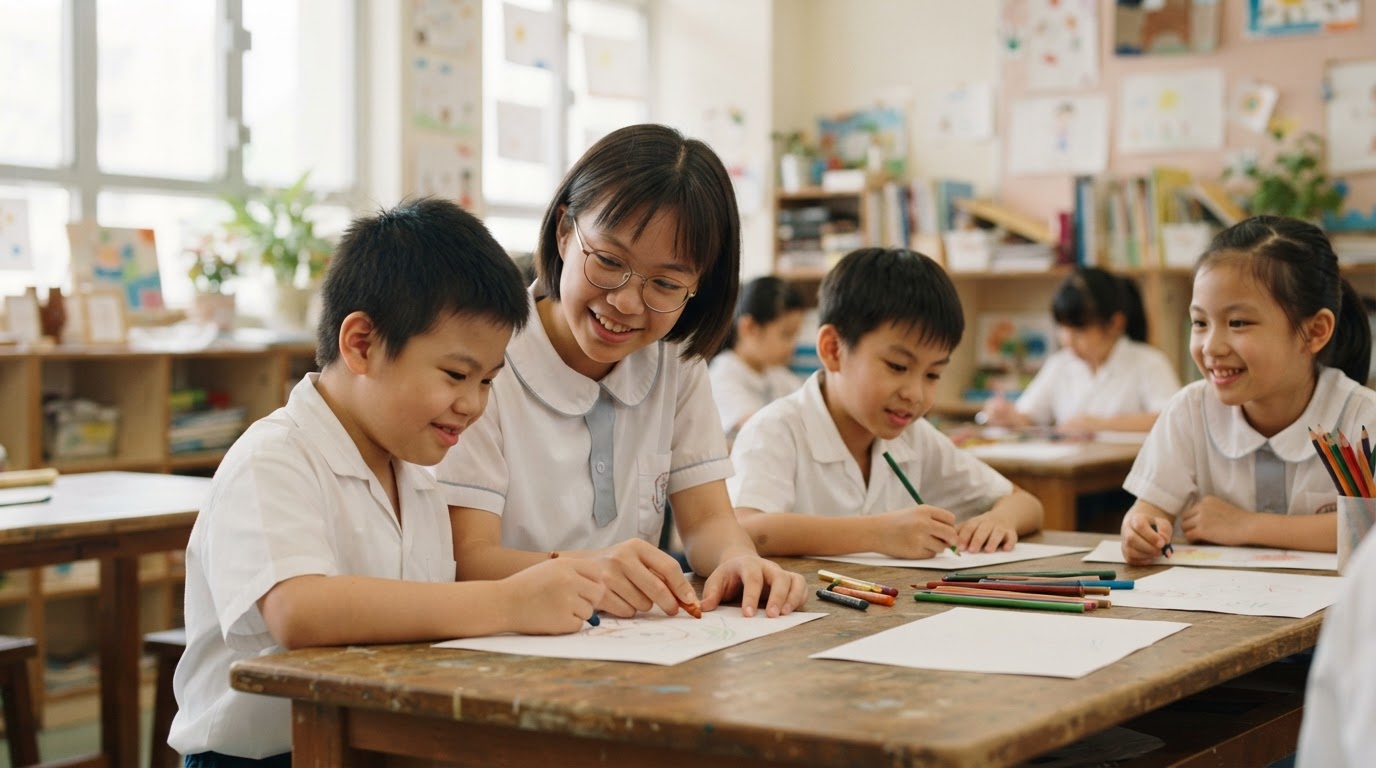
When a SEN child raises their hand and answers with a smile in front of the whole class, in that moment, they belong. What do you think we could do to give more children that moment?
📚 References
- Education Bureau. (2025). Number of students with special educational needs in public-sector schools, 2025/26 school year. Government of the Hong Kong Special Administrative Region. (More than 71,000 SEN students, a 26.7% rise over six years, reflecting mounting pressure on inclusive education.)
- Legislative Council Finance Committee. (2026). 2026/27 Estimates of Expenditure: Education Bureau. Government of the Hong Kong Special Administrative Region. (Around HK$4.43 billion budgeted for SEN support in 2026/27.)
- Baumeister, R. F., & Leary, M. R. (1995). The need to belong: Desire for interpersonal attachments as a fundamental human motivation. Psychological Bulletin, 117(3), 497–529. (Argues that the need to belong is a fundamental human motivation, supporting the view that belonging is at the heart of inclusive education.)
References