One Word, Thirty Years: Did 林作's Name Shape His Fate?
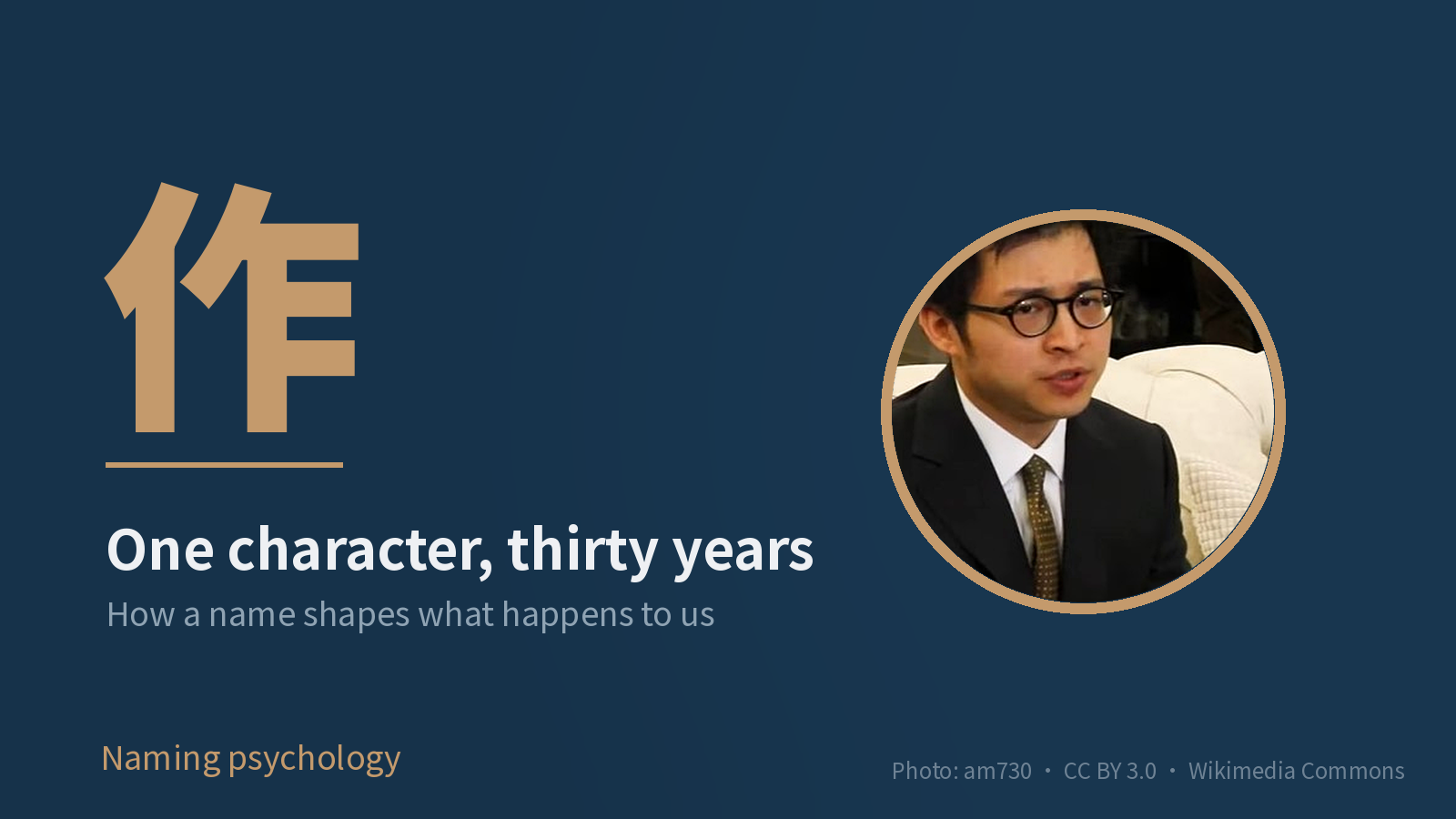
Most Hong Kong parents choose a name for luck: health, wealth, peace. But some names arrive carrying a trap that no one planned. His name is 林作, and the second character, 作, is one Hongkongers use every single day.
To exaggerate. To make things up. To put on a show. One character, three unflattering meanings.
🎭 One character, several readings
On its own, 作 is neutral, even positive: to create, to write, to compose, to author. Every one of those meanings is about making something from nothing. But Cantonese everyday speech pulls the same character in another direction:
- 作大 — to exaggerate; to turn one dollar into ten
- 作嘢 — to fabricate; to invent a story
- 作狀 — to pose; to put on an act
- 作反 — to rebel; to defy
Four common phrases, three of them unflattering. When a person hears his own name dozens of times a day, the character stops being a label and becomes a soundtrack that plays on repeat.
🧠 A name is a daily suggestion, not a one-off label
Psychology has a classic finding for this: the mere-exposure effect. The more often we encounter something, the more we tend to like it. Zajonc's 1968 experiments showed that repeated exposure shifted preference even when participants could not recall having seen the stimulus at all.
The mechanism cuts both ways. Repeated exposure to a good name builds affection. Repeated exposure to a name with an unflattering echo builds a frame, and everything you do afterwards gets read inside that frame.
Say something serious and people hear "there he goes again". Do something properly and people read it as performance. That is what a label does: it does not change you, it changes how others receive you.
📚 The path he actually walked
Set the online commentary aside and the record is plain. Born in 1989, educated in the United Kingdom at King's Ely and Harrow, then Oxford. Called to the Hong Kong Bar in 2015. In 2017 he gave up his practising certificate, signed a ten-year contract to teach IELTS, and later moved into insurance, content and social media.
Three reinventions, and the same criticism every time: a waste of a good education. Look again and he has been doing one thing throughout: authoring a new version of himself. The character is both the lens others see him through and the verb he uses to move forward.
🔍 What the research actually says
In 2012, Laham, Koval and Alter ran a set of experiments showing that how easily a name is pronounced changes how favourably we judge the person. Easy-to-pronounce names were rated more positively, and lawyers with easier surnames tended to reach higher positions.
Read that carefully. The effect is about first impressions, not verdicts. A first impression decides whether you get to speak. Everything after that is still decided by what you say and what you do.
A name decides how you are seen. It does not decide how far you go.
🎤 The Wynners: a name change, and a turn of fortune
Before 1973, the band now known as The Wynners performed as The Loosers, an unfortunate echo of "losers". On Uncle Ray's advice they renamed themselves The Wynners, pointing at "winners". What followed made them a legend of Hong Kong pop.
But what actually made them was a decade of practice and songwriting after the rename. The name got them through the door. It did not sing a single note.
🌱 If your own name feels like a disadvantage
- Choose a public version. An English name, a stage name, a pen name, a handle. You do not have to change your identity card to change what people call you.
- Test it in three languages. Say it in Cantonese, Mandarin and English. If any of the three carries a negative echo, it is not the right name yet.
- Overwrite the label with work. When someone defines you with a single word, the only answer that lasts is the work itself. Labels are applied by others. Content is written by you.
✨ In short: a name is a ticket, not a verdict
His name handed him a ready-made frame, and it may well have saved him a decade of building recognition. The same frame means every sentence he says has to pass through a filter first.
Names shape circumstances. They do not set destiny. What decides where you end up is what you choose to do after being misunderstood.
If you want to know how your own name lands in someone else's ear, book a free 10-minute WhatsApp consultation and we can take it apart together.
📚 References
- Zajonc, R. B. (1968). Attitudinal effects of mere exposure. Journal of Personality and Social Psychology, 9(2, Pt. 2), 1–27.
- Laham, S. M., Koval, P., & Alter, A. L. (2012). The name-pronunciation effect: Why people like Mr. Smith more than Mr. Colquhoun. Journal of Experimental Social Psychology, 48(3), 752–756.
- Wikipedia: 林作 (accessed November 2026).
If you want to know how your own name lands in someone else's ear, book a free 10-minute WhatsApp consultation.