Walnuts Like Brains, Watermelon Like Veins? Why We Agree with Stormtrooper on 「Like Cures Like」
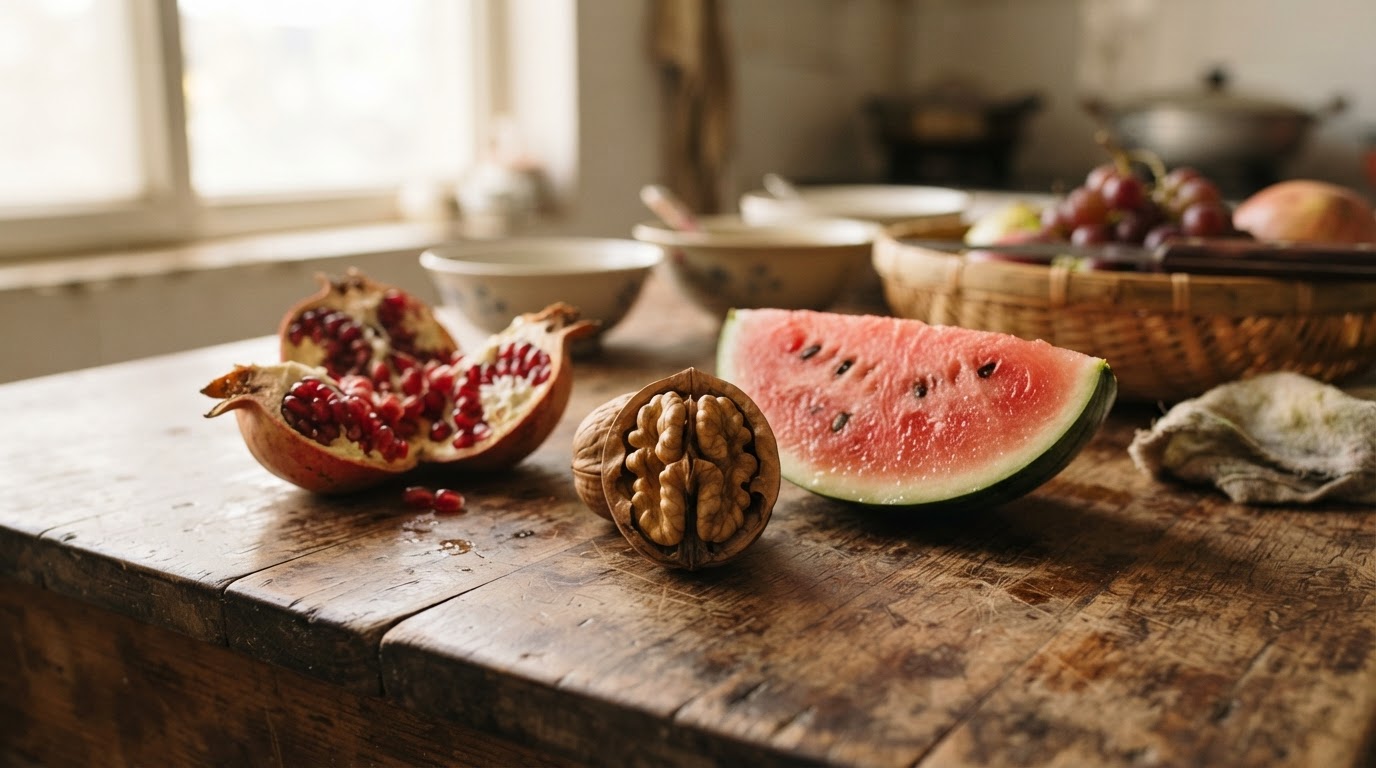
Recently I watched a video by the KOL Stormtrooper (白兵) called An Ancient Chinese Remedy: Is "Like Cures Like" Real?. He made a point in that video that we fully agree with, and couldn't wait to share it with you.
Have you heard of "以形補形" — "like cures like"? A walnut, cut open, looks like a brain, so it's said to nourish the brain. A watermelon, with its red flesh and fine streaks, looks like blood vessels, so it's said to help circulation. A pomegranate, with its red seed-like pearls, looks like eggs, so it's said to support fertility.
As children we dismiss these as old folks' superstition. But in his video, Stormtrooper takes them apart one by one — and it turns out quite a few have a basis in modern science: the omega-3 and polyphenols in walnuts really do support blood flow to the brain; the citrulline in watermelon helps relax blood vessels once it enters the body; and the polyphenols in pomegranate influence certain hormonal markers in some women.
But, Stormtrooper says, these "which-food-nourishes-which-part" pairings are not actually the point.
The real value is the ancients' way of observing nature. — and this is the point we fully agree with.
They had no blood tests and no microscope. What they had was long-term observation — watching how a thing grows, when it ripens, how the body feels after eating it, and passing those observations down generation after generation. This "relational thinking" places human beings and nature side by side, rather than tearing them apart to be studied in isolation.
And this is exactly the starting point for understanding ourselves.
Your insomnia may not just be "a tense brain". It may be linked to what you drank during the day, the environment you sit in, your relationships at home — all connected in countless subtle ways. The ancients knew this long ago — human beings are never isolated; we are connected to everything around us.
Hold nature's romance and a scientific attitude at the same time — the two, together, are the most complete way of observing.
The value of modern science is that it lets us verify: which observations are true, and which are coincidence. The value of the ancients is that they remind us: don't look only at one part or one symptom — look at the whole person and the whole environment.
Want to feel what it's like to be "truly seen"? Book a free 10-minute WhatsApp consultation and let's talk. 💛
參考文獻與學術延伸閱讀(References)
- Stormtrooper (白兵). 千年中醫古法:以形補形,究竟係咪係真? [Video]. YouTube. https://youtu.be/CkbjUUPk7ik