The Screen That Slowed Their Vocabulary Was Not the Child’s: It Was the Parent’s
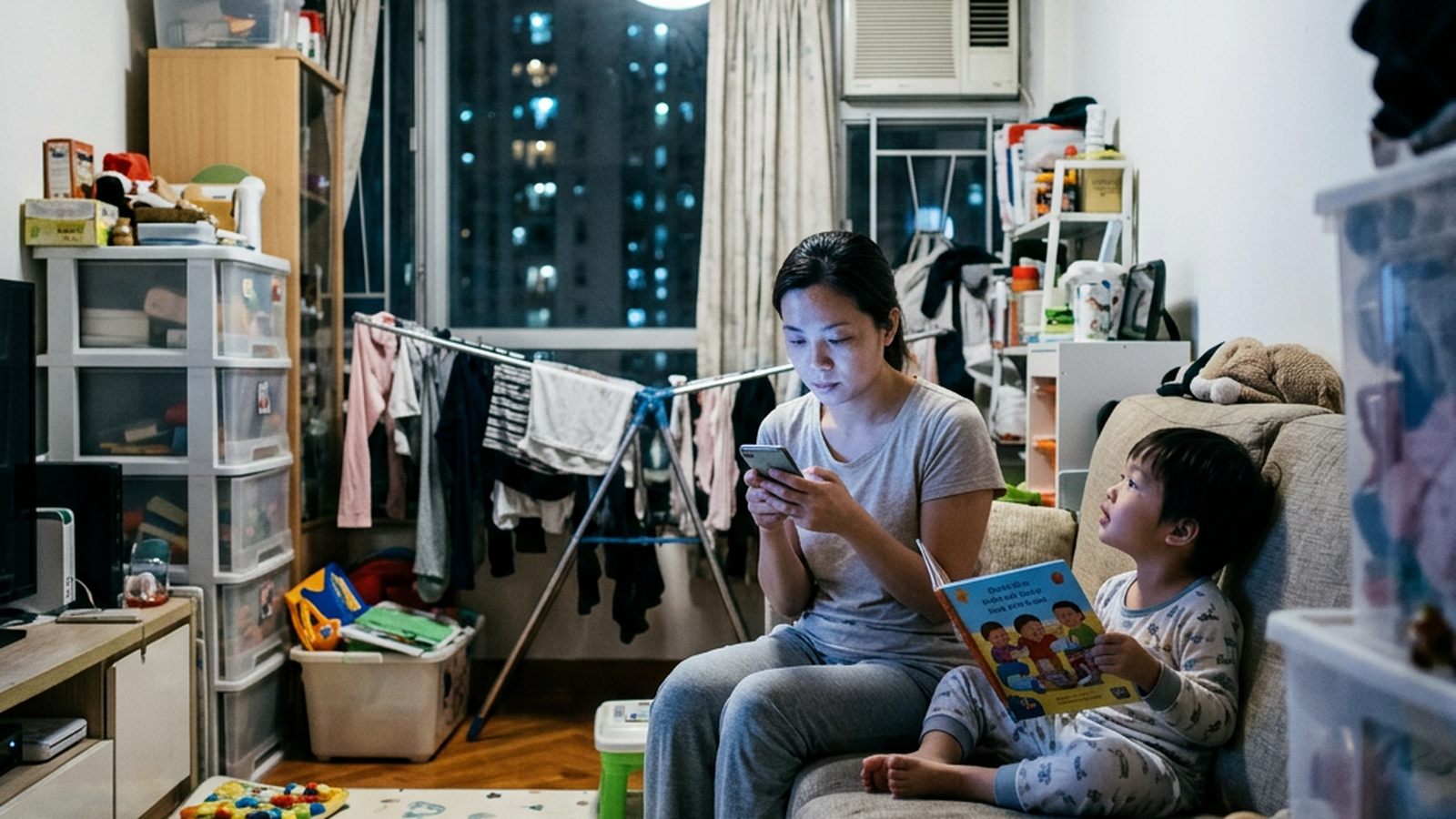
Have you ever had your child walk over with a picture book, saying “Mummy, look,” while you answered “mm-hmm” without lifting your eyes from your phone? 📱
A Norwegian study followed 747 children for three years to answer one question: which screen is actually slowing children’s language down?
The answer is uncomfortable: it is not the child’s screen. It is the one in the parent’s hand.
🔍 What the study did
A team at the Department of Special Needs Education, University of Oslo, used the Norwegian SpedAims cohort. They recruited 747 children in spring 2023 (mean age 4.9 years at baseline) and tested their language every year for three years: receptive vocabulary with the British Picture Vocabulary Scale, receptive grammar with the Test for Reception of Grammar.
Parents reported children’s weekday and weekend screen time and whether the child owned a tablet, computer or smartphone. Mothers and fathers separately reported daily social media use. The primary caregiver’s average daily smartphone time was taken directly from phone usage data (baseline mean 3.21 hours).
The crucial design choice was separating differences that already existed at baseline from change over time. Earlier studies found this step difficult, which is why the literature has been inconsistent: children who were already behind in language also tended to use more screens, and that pattern was read as “screens cause delay.”
📉 The results: counter-intuitive, slightly uncomfortable
- 🙅 Children’s own screen time: no significant association with language growth
- 🙅 Mothers’ and fathers’ social media use: also no significant association
- ⚠️ The primary caregiver’s phone: each additional hour per day was associated with 0.42 fewer points of annual receptive vocabulary growth (95% CI −0.66 to −0.18), and the association held after adjusting for family socioeconomic factors
- ➖ Receptive grammar: no association
- 📱 Children who already owned a device at age 4 to 5: 5.13 points lower at baseline in receptive vocabulary (95% CI −7.43 to −2.82) and 4.56 points lower in receptive grammar (95% CI −7.56 to −1.55), but the gap did not widen over the three years
The researchers’ reading is plain: the problem is not “toxic screens,” but the shared reading, storytelling and back-and-forth talk that the phone displaces. ⏳
🧠 Why the parent’s phone? Because turn-taking disappears
Children do not learn words simply by hearing more of them. They learn through turns: the child points, you name it; the child vocalises, you respond; you ask, they answer half a sentence. Researchers call it serve and return.
When an adult is looking at a phone, the child is still there, but the rally has no one on the other side. Vocabulary does not vanish from missing one sentence; it erodes across a year, which is where 0.42 points comes from.
And 0.42 points a year is statistically significant but practically tiny. The more interesting finding is the non-finding: how much screen time the child gets matters far less than whether the adult is present. 🎯
❤️ This is not about blaming parents
The easiest misreading is “parents lack self-discipline.” That is not what this is. 😌
3.21 hours a day is the product of a family rhythm: dual incomes, commuting, overtime, small flats, caring for elders, school group chats. The phone also carries the boss, the teacher, the family, the bank and the clinic appointment.
So the real question is not “why don’t you put the phone down,” but “does our daily life still have a slot where nobody needs an immediate reply from you?”
🧩 A holistic reading: four layers at once
- 👁️ Body: vocabulary grows through eye contact, mouth shapes and alternating sounds. That is bodily synchrony, not one-way input.
- 💗 Mind: the child is also learning “does my voice get a response?” That is a foundational belief about self-worth, not just language.
- 🏠 Environment: 3.21 hours is not a personal failing; it is working hours, housing and support systems. What has to change is the structure of dinner, bedtime and play.
- 🤝 Relationship: the key variable is not dosage. It is presence.
The traditional Western psychology view tends to break family life into measurable variables, such as minutes of daily screen time, and that angle helps us understand dosage. This study adds another layer: it measured something usually left outside the scale, whether the adult looked up.
🛠️ Three small things you can try tonight
- 🍚 For 20 minutes at dinner, every phone goes into another room, not face-down on the table.
- 📖 One picture book at bedtime. Do not test reading; ask “what do you think happens next?”
- 🌙 Before lights out: “Is there anything from today you want to tell me again?” Then wait. Do not fill the silence.
It does not have to be perfect. It just has to have turns.
✨ The one-line summary
What takes vocabulary away is not the screen. It is the hours of talking with you that never happened.
If you would like to look at your own family’s rhythm in practice, you are welcome to book a 10-minute WhatsApp consultation. We will look at it together, without judgement. 💛
References
- Yang, J., Furnes, B. R., Morken, F., et al. (2026). Screen use and children's language development from ages 5 to 7 years. JAMA Pediatrics. https://doi.org/10.1001/jamapediatrics.2026.3490 (747 Norwegian children, three annual waves; each additional hour of primary caregiver phone use associated with 0.42 fewer points of annual receptive vocabulary growth)
- EurekAlert. (2026, August 17). Screen use and children's language development from ages 5 to 7 years [Press release]. https://www.eurekalert.org/news-releases/1140056
- Contemporary Pediatrics. (2026, August 24). Parent smartphone use linked to slower vocabulary growth in young children. https://contemporarypediatrics.com/view/parent-smartphone-use-linked-to-slower-vocabulary-growth-in-young-children
- Romeo, R. R., Leonard, J. A., Robinson, S. T., et al. (2018). Beyond the 30-million-word gap: Children's conversational exposure is associated with language-related brain function. Psychological Science, 29(5), 700-710.
- Weisleder, A., & Fernald, A. (2013). Talking to children matters: Early language experience strengthens processing and builds vocabulary. Psychological Science, 24(11), 2143-2152.
- Tamis-LeMonda, C. S., Bornstein, M. H., & Baumwell, L. (2001). Maternal responsiveness and children's achievement of language milestones. Child Development, 72(3), 748-767.