"Mum, I'm Scared to Drink That": Talking to Kids After a Scary News Day
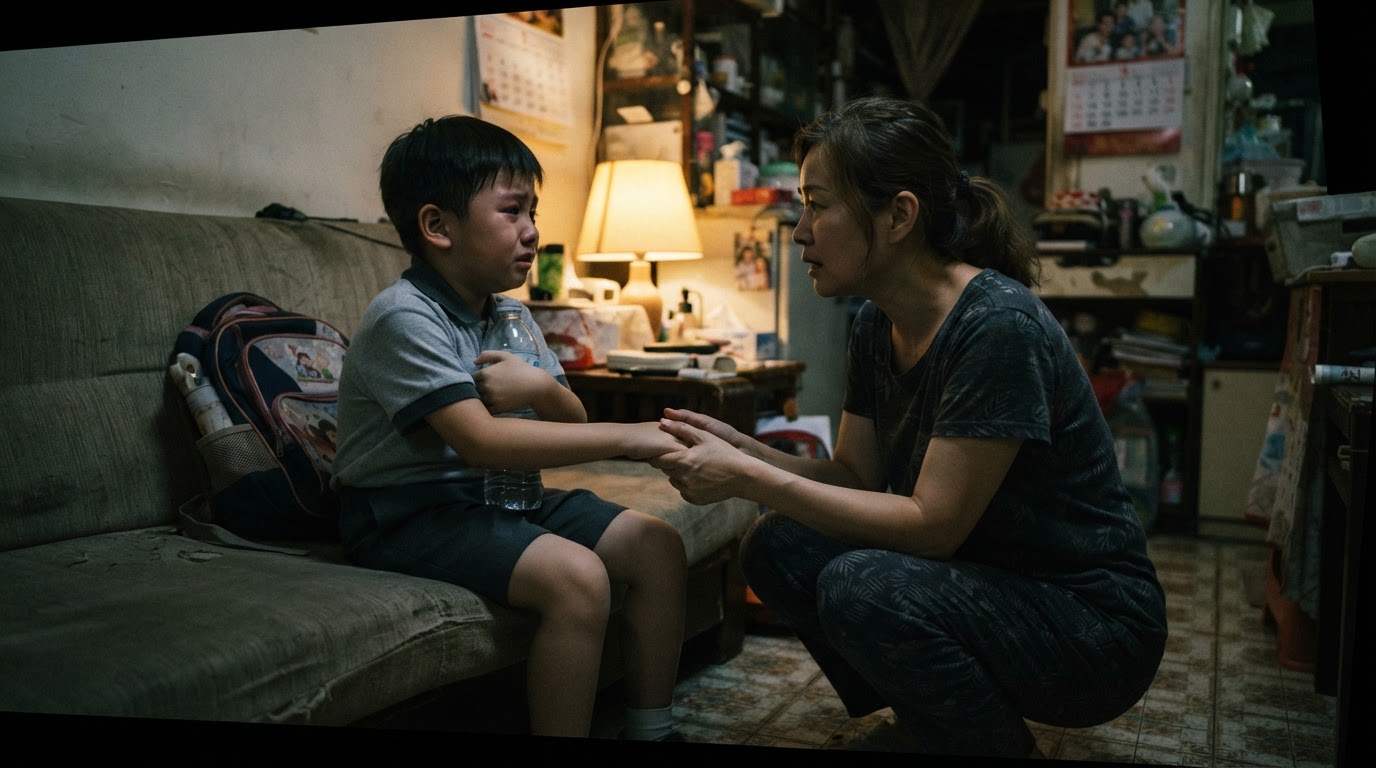
Outside a school sports day at Po Kong Village Road Park sports ground, someone was handing out sports drinks suspected of being tampered with. At least 12 students felt unwell and were hospitalised; police are investigating (am730/HK01, 2026-09-23).
But the people affected by this news go far beyond those 12 students.
That night, parents all over Hong Kong heard some version of the same sentence: "Mum, I don't dare drink water other people hand out." 😨
🌊 One Incident Shakes a Whole Community
The first principle of holistic psychology: the whole is greater than the sum of its parts. The shockwave of an incident never stops at the people directly involved — parents' hearts, trust between classmates, the sense of safety between a school and its community, all of it shakes together.
So if you felt unsettled yourself, that is normal. Children read the adults around them with great accuracy — before you say a word, they already know something happened.
🧸 Not Wanting to Drink Is Not "Making a Scene"
In the following days, children may refuse drinks handed out by others, avoid sports events, have nightmares, or become unusually clingy.
This is not cowardice, and it is not naughtiness. It is their body reporting honestly: that environment once carried a danger signal. The reaction itself is healthy — a body that tells the truth about its environment is doing exactly what it should.
The worst responses sound like: "Don't overthink it." "Big boys don't cry." "Keep whining and we're not going again." None of these make danger disappear; they only teach a child that feelings must never be spoken aloud.
💬 How to Open the Conversation: Three Steps
Step one: state the facts, briefly.
"Some drinks may have been tampered with, so the police are looking into it, and your school and I will always check things with you." — No graphic details needed. What a child needs is the message "the grown-ups are handling it", not a news replay.
Step two: share feelings — yours first.
"Mummy was frightened too, when I first heard." — When you model that fear can be spoken, your child dares to speak theirs. Then hand it over: "What went through your mind that day?" And then just listen.
Step three: return to "we".
"So we're careful together — we don't take food or drinks from strangers, and we tell a teacher straight away if we feel unwell." Safety is not built on "you watch out for yourself". It is built on "we are careful together". Research consistently shows that when parents can name and accept emotions, children's sense of security and later emotional regulation both improve markedly — and the feeling of being "held by the group" is itself the fastest route to recovery for a child.
📞 In the Days After, Watch for Three Things
1️⃣ Sleep and nightmares — a few rough days is normal; beyond two weeks, seek professional help.
2️⃣ Willingness to go to school — refusing school or group activities is a signal, not naughtiness.
3️⃣ Repeating the same story — children digest by retelling. Listen again; do not brush it off.
🌱 A Closing Thought
We cannot control the scary news. But what your child will remember is usually not the news itself — it is how the grown-ups held them that night.
To learn more about building a sense of safety with your child — or if your family is facing something similar — you are welcome to book a 10-minute WhatsApp consultation. We will figure out how to open the conversation, together. 💛
References
- am730/HK01 (2026, September 23). Suspected tampered drinks handed out outside school sports day; at least 12 students hospitalised. am730.com.hk/article/1054648
- Gottman, J., & DeClaire, J. (1997). Raising an Emotionally Intelligent Child. Simon & Schuster.
- Walton, G. M., & Cohen, G. L. (2011). A brief social-belonging intervention improves academic and health outcomes of minority students. Science, 331(6023), 1447–1451.
- Baumeister, R. F., & Leary, M. R. (1995). The need to belong: Desire for interpersonal attachments as a fundamental human motivation. Psychological Bulletin, 117(3), 497–529.