Your Child Says “I’m Bored.” How Fast You Hand Over the iPad Shows Up in Their Brainwaves
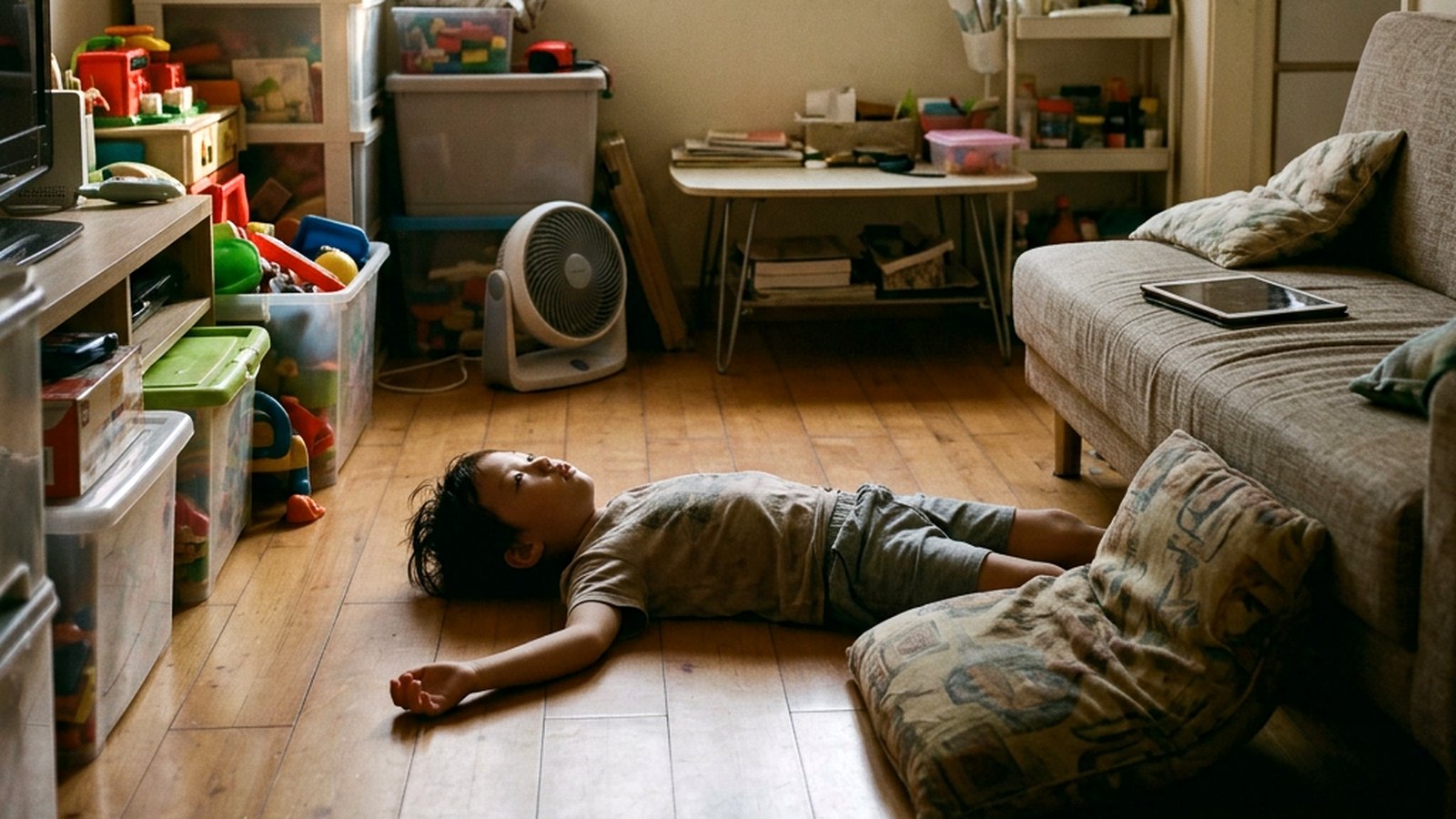
Three o’clock on a Sunday afternoon. The flat is so quiet you can hear the fridge compressor. Your child is flat on the living-room floor, staring at the ceiling, and says: “I’m bored.”
What is your first move? Turn on the TV? Hand over the iPad? Book one more weekend class?
Most of us reach for something to fill the gap. A 2026 EEG study suggests that how fast we reach may leave a lasting trace in how a child’s brain learns to cope.
🔍 What the study actually did
Sammy Perone and colleagues at the Lab for the Developing Mind, Washington State University, published the study in Infant and Child Development (July 2026 issue, DOI: 10.1002/icd.70119). The design was direct:
- 👦 83 children aged 4 to 6 (42 girls; mean age 5.27 years, SD = 0.79)
- 🧢 Each child wore an EEG cap while completing a task deliberately designed to induce boredom
- 📋 Parents completed a child-adapted boredom proneness scale, plus three questions about how they usually respond when their child is bored
- 📈 Researchers extracted slopes in frontal alpha asymmetry (FAA) across the task
The sample was 76.1% Caucasian, a textbook Western lab sample. We will come back to that. But the mechanism being measured, whether a child’s brain leans toward approach or avoidance when faced with emptiness, travels across cultures.
📊 Two counter-intuitive findings
- Trait boredom did not predict brain response (p > .05). Being a child who is “easily bored” is not the same as being a child who cannot cope.
- Children of parents who let them resolve boredom on their own showed a leftward shift (r = 0.31). Children of parents who habitually supplied an activity did not show this relationship.
An r of 0.31 is a moderate correlation, not a dramatic one. But the direction is clear: the less quickly adults intervene, the more a child leans into approach.
🧠 What “leftward” and “rightward” mean
Frontal alpha asymmetry is a long-established index of emotional motivation (Coan & Allen, 2004):
- ➡️ Leftward shift = approach motivation: moving toward, engaging, trying, leaning in
- ⬅️ Rightward shift = avoidance motivation: withdrawing, avoiding, disengaging
In a task where there is genuinely nothing interesting to do, approach is the strategy that fits: the only way out is to re-engage from the inside. The researchers describe these children as using a strategy that “matches the demands of the task well.”
The important detail: FAA is not a fixed personality score. It is a state index that moves with context. Which means this leftward tendency can be built through experience.
🎯 Why boredom is not a personality problem
The sentence worth remembering: boredom is a state, not a label.
If “being easily bored” were a fixed trait, parents could do little except accept it. But trait boredom did not predict the brain response; parental approach did. That makes this trainable.
This sits comfortably with a holistic view of development: a child is not a fixed personality card, but a system that shifts with environment, relationships, and bodily state.
🌀 What children learn when adults step in
The MAC model proposed by Westgate and Wilson (2018) is precise: boredom arises when we want to engage but cannot. At that point there are two routes:
- 🔄 Re-engage: change the approach, add difficulty, invent a new way to play
- 🚪 Escape: leave the situation, find another source of stimulation
Handing over a screen trains escape. Letting a child work it out trains re-engagement. The same minute, two different habits.
Bench and Lench (2013) add that boredom has a function: it signals that the current activity lacks meaning and pushes us toward something more meaningful. If the signal is covered the moment it appears, a child never learns to read it.
🎨 Emptiness and creativity
Mann and Cadman (2014) asked participants to complete an extremely boring task (copying phone-book numbers) before a divergent-thinking test. The bored group performed better on creativity measures.
Immordino-Yang and colleagues (2012) offer a neurological reading: during rest and idleness, the brain’s default mode network is highly active, doing social-emotional processing, memory consolidation, and meaning-making. Daydreaming is not the machine switching off. It is another mode of switching on.
For many parents this is the hardest part to accept: our instinct says “not doing anything” equals “wasting time.” Neurologically, emptiness has work to do.
📵 The side effect of constant rewards
Lepper, Greene, and Nisbett (1973) showed that children who already enjoyed drawing drew less in their free time once they expected a reward. The overjustification effect: external rewards can crowd out internal motivation.
Translated to a Hong Kong living room: if every bout of boredom is answered with a new stimulus, the lesson is that emptiness must be filled from outside. And outside will always be faster, brighter, and more entertaining than anything a child invents.
👨👩👧 Autonomy support is not neglect
Grolnick and Ryan (1989) found that parental autonomy support is associated with better self-regulation and perceived competence at school. Soenens and Vansteenkiste (2010) add that psychological control, manipulating a child’s thoughts and feelings, is associated with poorer adjustment.
Autonomy support does not mean stepping away. It means firm boundaries, with the process handed back to the child. “No screens today” can sit alongside “so what would you like to do? You choose.”
🧭 Through the four holistic dimensions
- 🫀 Body: approach is a neural habit shaped by experience, not a fixed trait. FAA moves with context, which means it can be practised.
- 🧠 Mind: boredom is a low-stimulation state that demands self-starting, which is exactly what executive function is: planning, sustaining engagement, tolerating mild discomfort.
- 🏠 Environment: the family timetable is an invisible variable. A schedule packed to the edges quietly removes the practice ground.
- 🤝 Relationship: a parent’s own tolerance for a child’s discomfort decides whether they step in. Co-regulation runs both ways; children settle because adults settled first.
These are not four separate checklists. They are four faces of one system. Move one and the others shift.
🏙️ The Hong Kong reality
Long working hours, care by domestic helpers or grandparents, weekends scheduled to the minute, and screens as the most convenient instant remedy.
The result: children rarely experience fifteen minutes with nothing to do. Those fifteen minutes are precisely the practice ground the study describes.
There is a subtler point. Many parents rarely experience emptiness themselves. The phone is always within reach: in the lift, at the bus stop, before the meal arrives. Children learn not only from what we say, but from how we treat our own empty time.
🛠️ Four things to try tonight
- ⏱️ Wait 60 seconds. No lecture. One sentence: “You feel really bored.” Then stop.
- 📦 Offer low-stimulation materials, not new stimulation. A cardboard box, old magazines, blocks, a stack of blank paper. The goal is for the child to begin, not for you to begin.
- 🕯️ Twenty screen-free minutes a day. The whole family, adults included.
- 🗣️ Ask afterwards: “How did you get through it?” Turn “I sorted it myself” into a story the child remembers. Narrative is the cheapest reinforcement there is.
⚠️ When to step in
This article is about ordinary boredom. Persistent low mood, anxiety, withdrawal, school refusal, or any safety concern needs proper attention, not a lesson in autonomy.
Boredom is low stimulation. Distress is pain. One can be companioned. The other needs help.
Traditional Western psychology vs holistic psychology: reading boredom
One phenomenon, two units of observation
| Dimension | Traditional Western psychology | Holistic psychology |
|---|---|---|
| Unit of observation | The individual’s internal state (trait boredom, EEG indices) | Child + family system + environmental rhythm |
| Setting of measurement | Laboratory tasks, standardised scales | Lab data plus observation of daily routines |
| Point of intervention | The child (training, regulation skills) | Adults’ response patterns + family time structure |
| Time horizon | Immediate response within a single task | Neural habits accumulated over years |
| Goal | Reduce an uncomfortable state | Expand the child’s capacity to hold emptiness |
The strength of traditional Western psychology is precision: it turns “boredom” into measurable variables, with EEG, scales, and statistics that leave little room for vagueness. That angle tells us that the timing of adult intervention has a neural basis, not merely a matter of parenting style.
Holistic psychology adds a further layer: the same brain, placed in a different family rhythm, grows a different tolerance. So the point of intervention is not only the child, but the adult’s bodily state, the household schedule, and our beliefs about what counts as “useful time.”
✨ One sentence to take home
Boredom is not the problem. Our tolerance for those few minutes of emptiness is what shapes the outcome.
“The goal is not to fill every minute for a child, but to sit with them through a few of them.”
If you would like to look at your own family’s rhythm together, you are welcome to book a 10-minute WhatsApp consultation. 💛
References
- Perone, S., Vaughan, A. M., Anderson, A. J., & Weybright, E. H. (2026). How parents support their children’s boredom relates to dynamics of neurophysiological correlates of self-regulation. Infant and Child Development, 35(4), e70119. https://doi.org/10.1002/icd.70119 (The present study: 83 children aged 4–6; trait boredom unrelated to FAA change; parental “let them resolve it themselves” associated with leftward shift, r = .31)
- Westgate, E. C., & Wilson, T. D. (2018). Boring thoughts and bored minds: The MAC model of boredom and cognitive engagement. Psychological Review, 125(5), 689–713. https://doi.org/10.1037/rev0000097 (Boredom arises when we want to engage but cannot; the way out is re-engagement or escape)
- Bench, S. W., & Lench, H. C. (2013). On the function of boredom. Behavioral Sciences, 3(3), 459–472. https://doi.org/10.3390/bs3030459 (Boredom signals that an activity lacks meaning and pushes us toward more meaningful goals)
- Eastwood, J. D., Frischen, A., Fenske, M. J., & Smilek, D. (2012). The unengaged mind: Defining boredom in terms of attention. Perspectives on Psychological Science, 7(5), 482–495. https://doi.org/10.1177/1745691612456044 (Boredom defined as an inability to engage attention)
- Mann, S., & Cadman, R. (2014). Does being bored make us more creative? Creativity Research Journal, 26(2), 165–173. https://doi.org/10.1080/10400419.2014.901073 (A boring task improved subsequent divergent thinking)
- Immordino-Yang, M. H., Christodoulou, J. A., & Singh, V. (2012). Rest is not idleness: Implications of the brain’s default mode for human development and education. Perspectives on Psychological Science, 7(4), 352–364. https://doi.org/10.1177/1745691612447308 (The default mode network is active during rest, supporting social-emotional processing and meaning-making)
- Lepper, M. R., Greene, D., & Nisbett, R. E. (1973). Undermining children’s intrinsic interest with extrinsic reward: A test of the “overjustification” hypothesis. Journal of Personality and Social Psychology, 28(1), 129–137. https://doi.org/10.1037/h0035519 (Expected rewards can erode intrinsic motivation)
- Grolnick, W. S., & Ryan, R. M. (1989). Parent styles associated with children’s self-regulation and competence in school. Journal of Educational Psychology, 81(2), 143–154. https://doi.org/10.1037/0022-0663.81.2.143 (Autonomy support is associated with better self-regulation)
- Soenens, B., & Vansteenkiste, M. (2010). A theoretical upgrade of the concept of parental psychological control: Proposing new insights on developmental antecedents and outcomes. Developmental Review, 30(1), 74–99. https://doi.org/10.1016/j.dr.2009.11.001 (Psychological control is associated with poorer adjustment)
- Coan, J. A., & Allen, J. J. B. (2004). Frontal EEG asymmetry as a moderator and mediator of emotion. Biological Psychology, 67(1–2), 7–50. https://doi.org/10.1016/j.biopsycho.2004.03.002 (Leftward frontal asymmetry indexes approach motivation; rightward indexes avoidance)